
West Indies: The Fugitive Slaves of Liberty
| 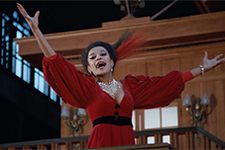 West Indies: The Fugitive Slaves of Liberty was actor-turned-director Med Hondo’s fifth feature film in less than a decade, which is a remarkable feat for any filmmaker, much less one working in sub-Saharan Africa in the 1970s, which had virtually no infrastructure or finances for film production. Although its highly self-aware theatrical style stood in stark contrast to the social-realist style of his previous films, several of which were documentaries, West Indies further cemented Hondo’s unwavering commitment to use his art to dramatize and draw attention to the plight of African immigrants and the unresolved tensions left simmering in the wake of decolonization. The entirety of West Indies takes place aboard a reconstructed 18th-century slave ship built inside an abandoned auto manufacturing plant outside of Paris. The stark contrast between the giant wooden ship and the dark industrial environment around it is initially jarring, especially as the ship is revealed via a long tracking shot, but the film’s overt theatricality and brazen merging of past and present through drama, song, and dance brings it all together. The different parts of the ship provide backdrop for a historical reenactment of the colonized history of the West Indies, beginning with the arrival of African slaves in the mid-17th century by the French, English, and Dutch and following through to the political struggles of decolonization in the mid-20th century. Hondo, who adapted French writer Daniel Boukman’s 1971 play Les négriers (The Slavers), focuses primarily on the French due to his own background as an African immigrant in France in the early 1960s, where he witnessed firsthand the callous and racist treatment of Africans in Europe. A significant portion of the film’s final third involves the crushed dreams of West Indies migrants who are promised a better life in France, only to see them crushed, which was the driving theme of several of Hondo’s previous films, most notably his feature directorial debut Soleil Ô (Oh, Sun, 1970). There are few named characters, but rather reoccurring figures who represent different faces of oppression, revolution, and the ordinary people caught between. The film opens with the faces of European oppression, which we come to learn represent official positions of power that profited in various ways from slavery and colonialism: a French parliamentarian (Robert Liensol), a social worker (Hélène Vincent), and an abbot (Philippe Clévenot). One of the few named characters is Deputy Justin (Robert Liensol), a black West Indian who has ascended to power by pretending to represent his people in government, but secretly colludes with the European colonizers. Black revolution is represented by a group that is figuratively and literally sidelined, calling out slogans and begging their friends and neighbors not to be taken in by European duplicity. Not having seen or read Boukman’s play, I can’t comment on how Hondo adapted it, but he was clearly invested in using a striking sense of artificiality to convey deep and distressing truths about history, which take various forms ranging from dramatic scenes, to figurative dance, to fourth-wall-breaking, the most profound example of which finds an entire group staring out at the audience, silently indicting them in their own suffering. If that all sounds didactic, it is, but Hondo never pretends otherwise and it is also leavened by plenty of mordant and satirical humor. His body of work was created over several decades to draw long overdue attention to issues of colonialism and oppression from a distinctly African perspective, something that, especially in the early years of his career, was not just ignored, but actively suppressed in European cinema. From a distribution perspective, this put his work in a double bind, because Africa at the time had few theaters and little infrastructure for film distribution and European distributors scoffed at African cinema that criticized them; thus, it is not surprising that many of Hondo’s films are only now being (re)discovered and given wider distribution through home video and streaming services (unfortunately, Hondo passed away in 2019). West Indies works if you are on its wavelength and open to a view of history that is rarely seen on-screen. If he piles it on too thick at times and the overall experience of the film feels a bit wearisome by the end (its overt theatricality is bracing, but also wears thin at some point), it is hard to begrudge him grasping what opportunities he had to make his voice, and so many like his that have long been suppressed, heard loud and clear.
Copyright © 2026 James Kendrick Thoughts? E-mail James Kendrick All images copyright © The Criterion Collection | |||||||||||||||||||||||||||||
Overall Rating:  (3)
(3)