
Birth (4K UHD)
| 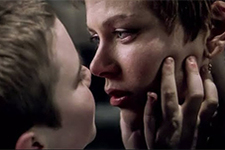 With its combination of foreboding, wealthy Upper East Side interiors, supernatural overtones, and Nicole Kidman’s pixie haircut, Birth was rightly compared to Rosemary’s Baby (1968) when it was first released, but the film it more closely resembled was the much less heralded Angel Eyes (1999), a possibly supernatural drama starring Jennifer Lopez and Jim Caviezel. Both films use hints of the supernatural to get at romanticism, but ultimately collapse in on themselves when the truth is revealed. More specifically, both films feature brooding male performances whose ominous, low-key pathos have more to do with forced style than any sensible character motivation. In Angel Eyes, Jim Caviezel moped around looking sullen and mysterious, not so much because his character would actually act that way, but because it added to the film’s aura and helped disguise its secrets. Birth features something similar in the performance of 10-year-old Cameron Bright, who moves through the film with a stone-faced solemnity that has nothing to do with the story and everything to do with the fact that, especially since the runaway success of The Sixth Sense (1998), all children in supernatural films have to act overly serious in a bid to generate creepy ambiguity—call it the “Haley Joel Osment Effect.” Unfortunately, in just a few years it had reached a level of tiresome cliché, whether in the American remake of The Ring (2001) or Godsend (2004)—the latter of which also featured Bright. Granted, in its opening passages, Birth is incredibly effective at creating a desolate, haunting atmosphere, an uncanny visual strategy that sustains it for much longer than it deserves (the cinematography by Harris Savides, who had previously worked with David Fincher and Gus Van Sant, is a towering achievement of desaturated visual art). British director Jonathan Glazer, in his sophomore effort after the incendiary gangster film Sexy Beast (2001), opens the film with an elegant tracking shot of a lone jogger running through snow-covered Central Park. The gray sky and washed-out surroundings run a visual counterpoint to Alexandre Desplat’s rising and falling score, immediately setting us on edge. The jogger enters a tunnel, has a stroke, and dies, and Glazer cuts fluidly to the hazy, dreamlike image of a baby emerging from a sea of amniotic fluid, thus making the clear suggestion that the life lost in Central Park has been transferred to this newborn child. Fast-forward 10 years, and we meet Anna (Nicole Kidman), the dead man’s widow. She is a member of New York’s storied class of old money, residing as she does in a cavernous, amber-hued duplex overseen by the family matriarch, Eleanor (Lauren Bacall). After many years of resisting, Anna has agreed to marry a respectable man named Joseph (Danny Huston), and it is at their formal engagement party that they first meet Sean (Cameron Bright), a 10-year-old boy who claims to be Anna’s reincarnated dead husband, whose name he shares. The films visual scheme creates gives the moneyed world of New York aristocracy an almost otherworldly feel, which makes Sean seem like that much more of an intruder (he comes from a working-class family). Of course, Anna assumes Sean’s claim is some kind of twisted juvenile prank. Yet, the boy won’t go away, and when he begins to reveal information that only her deceased husband would know, Anna allows herself to believe in what everyone else around her thinks is patently ridiculous. The moment in which Anna lets down her rational defenses is depicted in a stunning, three-minute close-up at an opera in which Glazer holds the camera’s gaze on Kidman’s face and allows her to convey the complex, conflicting interactions of faith, desire, and logic entirely with her facial expressions. We don’t need to hear a word to understand exactly what is going on in her mind, and it’s a moment of emotional nakedness worthy of Tarkovsky or Bergman. Which makes it all the more frustrating that Birth is such a maddeningly uneven film. Moments like the opera scene lure you into the idea that you are watching some kind of offbeat masterpiece, but when the whole starts to come together, you feel everything slipping away. Themes of obsessive love, familial discord, and class conflict float in and out of the story without ever really catching hold, partially because the film’s drive rests almost entirely on discovering whether or not Sean is really who he says he is, rather than exploring the ramifications of such a claim on all involved. When a long-buried secret is revealed by one of Anna’s old friends (Anne Heche), the solution to the mystery comes sharply into focus, and the screenwriters don’t seem to know exactly where to go from there (apparently, the screenplay was written and rewritten all throughout production). Co-screenwriter Jean-Claude Carrière worked on several of Luis Buñuel’s later films, including The Discreet Charm of the Bourgeoisie (1972) and That Obscure Object of Desire (1977), and it isn’t hard to imagine that, had Buñuel directed Birth, a great many things would have been left unexplained and the absurdity of the situation would have become the primary focus. That might have made for a fascinating viewing experience, but that is not the film presented here. Rather, the desire to explain everything in Birth kills the spare, mystical aura its opening passages had worked so hard to generate, leaving it feeling empty when it should have been heart-wrenching. Anna’s falling in love with her dead husband in the form of a 10-year-old boy seems ridiculous on its face, yet Kidman is so good that she convinces us that an otherwise intelligent, rational woman could allow herself to believe the impossible if it fulfilled her deepest, unspoken desires. This, of course, brings us back to Bright’s performance, which is essentially the same as his work in Godsend, where he acted solemn and weird (does he ever blink?) just for the sake of being solemn and weird. Granted, it has a certain effectiveness near the beginning, and it certainly adds to the idea that this could be a man in a boy’s body, but after a while it just gets irksome and calls into question Anna’s growing obsession with a creepy kid. Birth has a lot going for it, but its unfocused approach and thematic laziness ultimately turns it into a tableau of elegantly eerie moments in search of something to say.
Copyright © 2026 James Kendrick Thoughts? E-mail James Kendrick All images copyright © The Criterion Collection / Warner Bros. | |||||||||||||||||||||||||||||
Overall Rating: 
 (2.5)
(2.5)