
The Plague
| 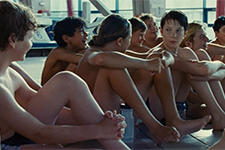 The Plague is director Charlie Polinger’s feature debut after 15 years of making short films, and he is clearly an emerging master of mood and atmosphere, although at the expense of character. He has cited Stanley Kubrick and Catherine Breillat and Claire Denis as inspirations, and it shows in his work. The Plague unfolds like a paranoid dream, with each scene cutting hard into the next with just enough apparent rationality to keep the whole enterprise from collapsing, and it is precisely this teetering balance within that dangerous liminal space that makes The Plague so compelling, so engaging, so unnerving. Many of the film’s most haunting shots take place underwater in a massive swimming pool, which makes sense given that the film unfolds entirely within the confines of an all-boys water polo camp (it ostensibly takes place in the U.S. in the early 2000s, but it was shot in Bucharest, which creates just the right amount of cognitive dissonance—nothing looks quite right, but not really wrong either—to sustain the film’s fever-dream pitch). Deep water becomes a recurring visual motif, which reinforces the alien nature of the film’s parameters by emphasizing how the laws of physics—movement, gravity—don’t play the same when you’re surrounded by liquid, just like the laws of the adolescent male social world don’t always play by the rules of common decency and humanity. The film’s protagonist is a quiet 12-year-old named Ben (Everett Blunck), who is a new arrival at the water polo camp. Lanky, introspective, with wide-set eyes and a tight mouth (he looks quite a bit like Michael Cera, who probably would have played the role 15 years ago), Ben is initially an observer of the social milieu around him, and he quickly learns that the rest of the boys have ostracized one of their own, an awkward-looking boy named Eli (Kenny Rasmussen). Eli is softer and rounder than the others, which makes him visually distinctive and therefore a target. However, his ostracization centers on the other boys’ contention that he is infected with some kind of skin disease that they will also catch if they get too close to him. The fact that Eli always wears a long-sleeved swim shirt while the other boys are bare-chested adds credence to their accusations. However, questions persist: Did they make up the “plague” as justification to shun Eli, or are they legitimately afraid? If the fear is real, does that mean that the contagion is real, as well, or is it just in their minds? All of those possibilities dangle in the dank air of the swim facility, and Ben finds himself caught in the middle; he wants to fit in with the others, but, at the same time, he feels for poor Eli and his social and physical isolation. Whether the skin lesions are physical reality or psychological contagion is ultimately unimportant because, either way, they confirm the power of social control and its link to discomfort with changing bodies. While so many movies about adolescent girls focus on body insecurity, The Plague uses body horror to shine that light on male insecurities (the fact that the boys are physically exposed as part of their sport—visually and physically vulnerable—only underscores those insecurities). As with William Golding’s 1954 novel Lord of the Flies, which remains of the most powerful and haunting expositions of the potential for human cruelty as filtered through adolescent male social rituals, adults are mostly nonexistent in the world of The Plague. The only recurring adult figure is a water polo coach, Daddy Wags (Joel Edgerton), whose attempts to impose order on the boys’ world is largely ineffective, especially as the boys always find ways to do what they’re going to do in the shadows of their ostensible supervision (one particularly harrowing nighttime scene in the dorm room is a direct homage to Kubrick’s Full Metal Jacket). Polinger, working again with cinematographer Steven Breckon, who shot many of his earlier short films, turns the immense architecture of the swimming facility, with its arches and heavy bricks and air of Old World dread, into an inescapable microcosm that all but ensures that the narrative’s steady march will lead to tragedy. Whatever innocence and decency Ben brings with him into that world is destined for destruction. I would be remiss if I did not mention that much of the film’s effectiveness hinges on the performance of a young actor named Kayo Martin, who is making his feature debut as Jake, the sadistic ringleader of the world in which Ben finds himself immersed. However, Martin doesn’t play him as a vicious, physical bully, but rather as a sly master of psychological manipulation. Martin is not a big kid and he isn’t particularly handsome; he has a boyish face and a tousle of curly hair that would make him perfect for playing a victim in another movie. But, here he shows that size and looks don’t matter when you have emotional and social control. His sly looks and little smirks convey his complete dominance of everything around him (before turning to acting, Martin had been a competitive boxer and skateboarder, and perhaps some of that physicality seeps into his confident body language). Jake is a terrifying character because his violence is all emotional—he gets into the head of the kids around him without them even noticing, and he gets into our head, too. He is the perfect embodiment of the kind of despot who never lifts a finger against anyone else because he can manipulate those around him to do it for him. Like the rest of the film, he feels slightly alien, but also terrifyingly real. Copyright © 2025 James Kendrick Thoughts? E-mail James Kendrick All images copyright © Independent Film Company |
Overall Rating: 
 (3.5)
(3.5)