
No Other Choice (Eojjeolsuga eobsda)
| 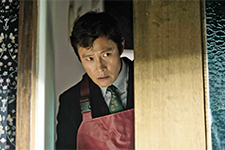 Park Chan-Wook’s pitch-dark satire No Other Choice (Eojjeolsuga eobsda) is his first feature film in three years. His last feature, Decision to Leave (Heojil kyolshim, 2022), for which he won the Best Director award at Cannes, was a Hitchcockian romantic thriller that eschewed the usual visceral sex and violence of his earlier international hits like Oldboy (2003) and The Handmaiden (2016). No Other Choice is similarly less graphic and bloody, but rather than being suffused with romantic fatalism, it blisters with sharp invective aimed at how the callousness of capitalism does not just destroy good men, but turns them into monsters. The fact that much of it is darkly comical only sharpens its edges. The film was adapted from the 1997 novel The Ax by American crime writer Donald E. Westlake (Costa-Gavras previously adapted it in France as Le couperet in 2005). Park’s film has been in some form of development for at least the past 15 years. It was originally planned to be an English-language production, with Park collaborating on the screenplay with Canadian actor/writer/director Don McKellar (Last Night, Blindness), who still shares co-screenwriting credit along with Park, Lee Kyoung-mi, and Jahye Lee. At some point, Park chose to relocate the story to his native South Korea, although much of the plot and the force of the protagonist’s twisted moral dilemma remains firmly in place, which only serves to emphasize the universality of the loyal company man’s tragedy. The story centers on Yoo Man-su (Lee Byung-hun), a long-time executive of Solar Paper, a large pulp processing company. He has a beautiful, loving wife named Mi-Ri (Son Ye-jin), a teenage step son named Si-one, and a daughter, Ri-one, who is a cello prodigy. The film opens with an almost parodic postcard depiction of familial-economic bliss, as Man-su grills eels sent to him by the company’s upper executives outside of his large country house. “Know what I’m feeling right now? I’ve got it all,” he happily declares, which makes his imminent downfall all the more blistering. As it turns out, Man-su’s job (along with many others’) at the paper company are on the chopping block after an American corporate take-over, and he finds himself out of a job and unable to find new employment. The blissful lifestyle to which he and his family had grown accustomed was built on debt, and once his income stops rolling in, the bills start mounting. Man-su is particularly reluctant to give up their house because it was the one he grew up in and he spent almost all of their savings acquiring and renovating it. At this point, the film is a kind of sullen tragedy, with Man-su’s carefully manicured success crashing on the shoals of (American) corporate indifference. It also plays as a brutal deconstruction of traditional masculine identity and how it is so completely wrapped up in the position of being the family provider. Once Man-su is stripped of his socially and economically rewarding job and virtually any hope of ever being employed in such a prestigious position again dwindles, he crumbles as an individual. He loses it. Reduced to working a retail job and suffering the indignity of watching Mi-ri return to part-time work as an assistant in the office of a younger, handsome dentist, Man-su reaches levels of jealousy and sordid desperation that eventually turn murderous (one can’t help but think of American Psycho’s verbal twisting of “mergers and acquisitions” into “murders and executions”). While many corporate satires equate violence with moving up the corporate ladder, No Other Choice, as the title suggests, locates it on the much lower rungs of simple survival. Man-su doesn’t want to rise to the top; he just wants to be back on the ladder. As he has shown in his previous films, Park Chan-wook is a master of narrative and tonal twists and turns, and No Other Choice is no different. It features its fair share of corpses and cringe-inducing moments of physical brutality (including the pulling of a tooth and the tease of dismemberment via chainsaw), but where the film works most effectively is in the darkly comedic incompetence with which Man-su executes his plans. He covets the line manager job at a rival paper company held by Choi Seon-chul (Park Hee-soon), plots to kill him, and then targets the two men who might also apply for the job: a struggling alcoholic (Lee Sung-min) with a bitter, unfaithful wife (Yeom Hye-ran) and a good-natured shoe salesman (Cha Seung-won). He plots their demise in ways that go exceedingly wrong, but still results in a body count, albeit usually with a lot of collateral damage. What at first feels like a narrative weakness—Man-su, the paper expert, is no killer!—becomes the very backbone of the film’s morbid humor. Lee Byung-hun, who first collaborated with Park 25 years ago on his third feature Joint Security Area (Gongdong gyeongbi guyeok JSA, 2000), makes Man-su a fascinating mix of the maniacal and the absurd—a perfect avatar for our deeply troubled times. Copyright © 2025 James Kendrick Thoughts? E-mail James Kendrick All images copyright © Neon |

Overall Rating: 
 (3.5)
(3.5)