
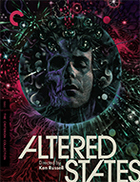
Altered States (4K UHD)
|  Ken Russell’s Altered States is a trip of a movie despite being quite possibly the most mainstream thing the eccentric British director ever made. Adapted by lauded playwright and screenwriter Paddy Chayefsky from his 1978 novel (the only one he ever wrote), it merges science fiction with heady counterculture drug-speak, producing an overheated mishmash in which technology and spirituality unlock the secrets of human evolution. Russell, a filmmaker of singular vision and intent, naturally butted headed with Chayefsky, who had recently won an Oscar for his screenplay for the acerbic media satire Network (1976), which is why he had his screenwriting credit go to the pseudonym Sidney Aaron (his actual first and middle names). No surprise there. Russell had spent the previous decade producing one provocation after another, beginning with his supreme achievement in controversy, The Devils (1971), which proved that he was willing to do just about anything to get a reaction. Many of his films in that period were lush-perverse biopics designed to demystify their subjects and enrage their fans: The Music Lovers (1971) about the Russian composer Peter Ilych Tchaikovsky; Savage Messiah (1972) about the French sculptor Henri Gaudier-Brzeska; Mahler (1973) about the Austro-Bohemian Romantic composer Gustav Mahler; Lisztomania (1975) about the Hungarian composer and pianist Franz Liszt; and Valentino (1977) about the American silent film star Rudolph Valentino. All of these films were historically dubious (to put it mildly), but brash and entertaining and often ludicrously over the top to the point of tastelessness (one could point to Russell’s staging of Tchaikovsky’s 1812 Overture as a fantasy in which cannons literally blow people’s heads off). Thus, making a science fiction film set in the present day was something of a departure for Russell, as the last time he had made a film not set in the historic past was his absurd adaptation of the Who’s rock opera Tommy (1975). Altered States didn’t offer any musical numbers or tragic historical artists, but it did offer a gonzo sci-fi concept in which a brilliant scientist named Edward Jessup (William Hurt) becomes determined to fuse isolation chamber techniques with ancient drugs to tap into the deepest recesses of human existence, namely the collective unconscious where our evolutionary prehistory still resides. He does this with the help of his assistant, Arthur Rosenberg (Bob Balaban), and much to the consternation of his beleaguered, long-suffering wife, Emily (Blair Brown). Russell views Jessup as a kind of mythic artist-hero, who works in science the way his composer-heroes worked in music. An outlaw, a renegade, a true believer—Jessup is the kind of anti-establishment anti-hero whose days were numbered at the dawn of the Reagan Era, when violent war-raging heroes played by Sylvester Stallone, Chuck Norris, and Tom Cruise were more in vogue. Altered States was part of the dying end of the Hollywood counterculture revolution that had begun in the late 1960s—too little, too late. What most people remember about Altered States are its Dayglo vision sequences, which play like the Stargate sequence from 2001: A Space Odyssey (1968) merged with a low-budget horror film (the ahead-of-its-time synth score by John Corigliano helps quite a bit). These sequences are weirdly convincing in their visual audacity, and even though they don’t represent any kind of major step forward in visual effects, they still feel quite extraordinary. Part of this is because they are tied so well to Jessup’s monomania, his unrelenting quest to tap into something no one else ever has. In this regard, William Hurt, in his big-screen debut, is very good, making Jessup both deranged and empathetic. He does a fantastic job playing the internally directed intellectual, which is why it is so ironic that he played a dim-witted news reporter equally well seven years later in James L. Brooks’s Broadcast News (1987). Jessup’s drive naturally runs up again ethical considerations, which is why Charles Haid is on hand as a fellow scientist to dismiss his ideas as fantastical, misguided, or just plain wrong. But, as science fiction has taught us over and over again, the mad scientists may be mad, but they are always onto something.
Copyright © 2025 James Kendrick Thoughts? E-mail James Kendrick All images copyright © The Criterion Collection | |||||||||||||||||||||||||||||
Overall Rating:  (3)
(3)