
Dodes'ka-den
| 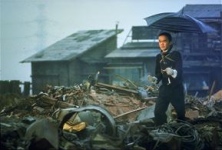 The title of Akira Kurosawa’s Dodes’ka-den is not a real word, but rather an onomatopoeia for the sound of a trolley car clacking along its rails that is used by a simple-minded teenager who lives in a shanty-town slum on the outskirts of Tokyo. The film begins and ends with the boy, thus making his absorbed, dream-like evocation of mass transit--one of the great symbols of 20th-century technological and social progress--a metonymic bookend for the film’s depiction of the forgotten denizens of Japanese society and their various dreams, hopes, and tragedies. The film takes place entirely within the slum, which Kurosawa shot in an open-air garbage dump, thus its singular focus is on the dispossessed, with only hints of the society of which they can never be a part. The title of Akira Kurosawa’s Dodes’ka-den is not a real word, but rather an onomatopoeia for the sound of a trolley car clacking along its rails that is used by a simple-minded teenager who lives in a shanty-town slum on the outskirts of Tokyo. The film begins and ends with the boy, thus making his absorbed, dream-like evocation of mass transit--one of the great symbols of 20th-century technological and social progress--a metonymic bookend for the film’s depiction of the forgotten denizens of Japanese society and their various dreams, hopes, and tragedies. The film takes place entirely within the slum, which Kurosawa shot in an open-air garbage dump, thus its singular focus is on the dispossessed, with only hints of the society of which they can never be a part.Based on a collection of stories by Shugoro Yamamoto (whose works were also the basis of Kurosawa’s Sanjuro and Red Beard), Dodes’ka-den has no central plot or protagonist, but rather a collection of characters whose various experiences, which range from the comical to the tragic, create a rough collage of life on the edge that is painted with a sense of absurdity that never quite undermines the characters’ shared humanity. Kurosawa, ever the humanist, had always been interested in the lives of the unfortunate, and many of his films turn on stories of exploitation and the abuse of the powerless (after all, for all its sound and fury, his 1954 masterpiece Seven Samurai is ultimately about a peasant village that must be protected by a rogue’s gallery of ronin samurai--the rejected protecting the rejected). Dodes’ka-den allowed Kurosawa to make poverty and rejection the film’s central motifs, and he explores their manifestation via a series of interlocking narratives, which include a cycle-of-violence story about a young girl who is abused by her uncle and ultimately takes it out on a friendly delivery boy, a comical story of a pair of drunkards and their constantly complaining wives, and the film’s most moralistic tale, which involves an elderly doctor who shows Christ-like charity to a man who tries to rob him. Most poignant, though, is the story of a beggar and his son who live in the rusting shell of a car and spend their time fantasizing about a beautiful home, which Kurosawa renders in nearly surrealistic (or just plain kitschy) dream images. Dodes’ka-den was Kurosawa’s first color film, which is something of a surprise given that he was initially trained as a painter whose canvases were bold exercises in deeply saturated hues. Kurosawa had avoided color film until Dodes’ka-den mainly because he was dissatisfied with existing color film processes, but once he made the transition, he did it with trademark vigor. Despite its lowly subject matter, Dodes’ka-den is a visually striking film that uses color with great, almost emphatic vitality. Not wanting to simply reproduce visual reality, Kurosawa and cinematographers Yasumichi Fukuzawa and Takao Saitô (the latter of whom would go on to shoot three of Kurosawa’s last four films) use color abstractly and symbolically, turning the screen into a vivid moving painting (quite literally at times, as some scenes feature a painted sky that is clearly fabricated). This results in a film that is undeniably beautiful, although the intensity of the colors sometimes feels at odds with the drab subject matter and detracts from the potential for emotional power. When Kurosawa made Dodes’ka-den, it was during a particularly difficult time in both his personal life and his professional career when he was stranded in what would become a nearly decade-long gray zone between his internationally acclaimed masterpieces of the 1950s and ’60s and his late-period revival in the ’80s. It had been five years since he has directed a film (1965’s Red Beard, his last collaboration with Toshiro Mifune and what Kurosawa himself saw as the culmination of his work), and much of that time had been spent working on an aborted 70mm Japanese-American coproduction that would be realized nearly 20 years later as Runaway Train (1985) by Russian director Andrei Konchalovsky and planning and shooting sequences for the 20th Century-Fox production Tora! Tora! Tora! (1970), from which he was subsequently fired and replaced by Kinji Fukasaku and Toshio Masuda. In a time when the Japanese film industry was in decline, Kurosawa’s lengthy and expensive productions found little room, which is why he had to experiment with a quicker and cheaper approach. In Dodes’ka-den’s slum dwellers he found the perfect subject to fit his budgetary needs, which he hoped would translate into a bold proclamation of independence and continued artistic integrity. Unfortunately, the film failed miserably with critics and audiences, and Kurosawa attempted suicide the following year by slashing his neck and arms 21 times (his later recuperation was aided by letters from schoolchildren promising to raise money for his next project). Thus, the tragedy in Dodes’ka-den spilled out into the life of its filmmaker, and even if the film does not stand up with Kurosawa’s better known works, it is still an intriguing, if only semi-successful, experiment that suggests the great director’s willingess to expand his palette.
Copyright ©2008 James Kendrick Thoughts? E-mail James Kendrick All images copyright © The Criterion Collection | |||||||||||||||||||||||||||||||||

Overall Rating: 
 (2.5)
(2.5)